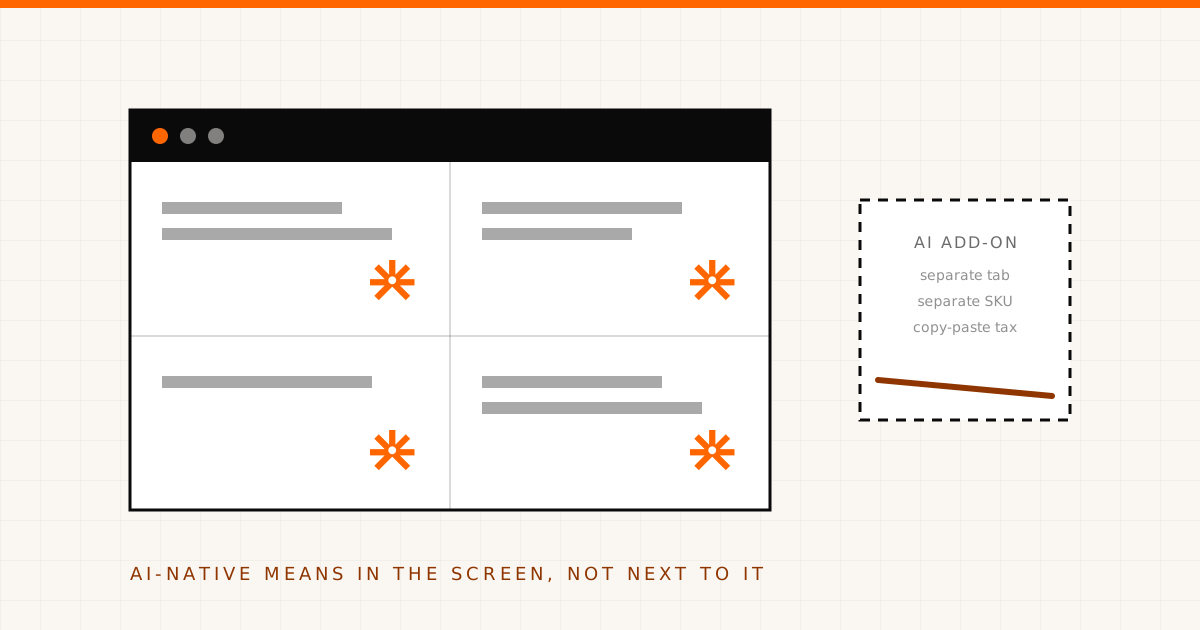
“AI-native” means the assistance lives inside the screens you already use — and a human approves every output — instead of arriving as a separate chatbot SKU bolted onto software that was built before any of it existed. It’s a difference you feel in the workflow, not on the pricing sheet.
The phrase gets thrown around enough that it’s worth being concrete. Most event tools that advertise “AI” today added it the same way: a panel in the corner, an “AI Assistant” upsell on the plan comparison, a credits meter. The underlying product didn’t change. You still do the work the old way, then walk to a different room to ask a robot for help, then copy the answer back. That’s an AI add-on. It can be useful. It is not native.
The bolt-on tell
You can spot a bolt-on by where the AI sits. If it has its own tab, its own line item, and its own onboarding video, it was added next to the product rather than into it. The giveaway is the copy-paste tax: the AI produces text somewhere else, and you’re the courier moving it back to where the work actually lives.
Native is the opposite. The help shows up at the exact moment and place you’d want it, on the record you’re already looking at, and the result lands in the field you were already editing. No new tab. No credits screen. No courier.
What that looks like in practice
Here’s how it plays out across AgendaForge, with the honest edges left in.
Rewrite where the text already is. When a speaker bio reads rough or an abstract runs long, you don’t open a separate writing tool. Studio Remix rewrites it in place — improve, shorten, expand — and you accept or discard the result. The text never leaves the field it belongs to.
Read the whole pile, not one row. Pipeline Pulse looks across your entire submission pipeline and tells you which topics you’re light on, what’s trending, and which proposals look like likely duplicates. That’s a judgment you’d otherwise make squinting at a spreadsheet at 11pm. It surfaces inside the pipeline you’re already triaging.
Search by meaning. Smart Search finds people by what they’re about, not just by exact-match name. Type the gist — “fintech founders who can talk about compliance” — and it ranks the closest matches. Honest limit, stated plainly: today this is people-scoped. It searches across your speakers and contacts, not yet across sessions or everything else in the event. We’d rather tell you the boundary than let you trip over it.
Suggest the slot, flag the clash. While you build the schedule, Agenda AI proposes open slots and flags room and speaker double-bookings as you go. Another honest limit: this is an authoring-time aid, not a server-enforced guarantee. It catches the conflict you’re about to create so you can fix it before it ships — but you’re still the one who approves the layout. It’s a sharp second pair of eyes, not a lock on the door.
Enrich, then confirm. Contact Enrichment suggests a missing company, title, social handle, or bio for a person in your directory. It never just writes the field. You approve each one.
The thread that runs through all of it
Two things are true of every example above, and they’re the whole point.
First, the AI met you where the work was. You didn’t go to it.
Second, you approved the output. Every rewrite, every enrichment, every agenda move is a suggestion you accept — not a change that happens to your event while you’re looking the other way.
AI-native isn’t “the software does it for you.” It’s “the software does the reading and the drafting, and you keep the decision.”
That second part matters more than the first. Events are reputational. A mangled speaker bio, a double-booked keynote, or a wrong company name on a sponsor isn’t a typo — it’s something your attendees see with your name on it. Human-in-the-loop isn’t a compliance footnote we tack on; it’s the design constraint that makes built-in AI safe enough to actually use on the stuff that goes public.
How to test the claim yourself
Next time a tool tells you it’s AI-native, ask three questions. Where does the AI live — in the screen I’m working in, or a different one? Who has the final say — me, or it? And is it a feature of the product, or a separate thing I’m being upsold? If the answers are here, me, and built in, the label is earned.
That’s the bar we hold ourselves to. The AI rides along inside the call for papers, the pipeline, the directory, and the agenda — drafting, reading, and flagging — while your team keeps every decision. No add-on SKU, no credits meter, no copy-paste tax.
You don’t need AI to run a great event. But if it’s going to be there, it should be in the room with you — not down the hall, waiting to be asked.