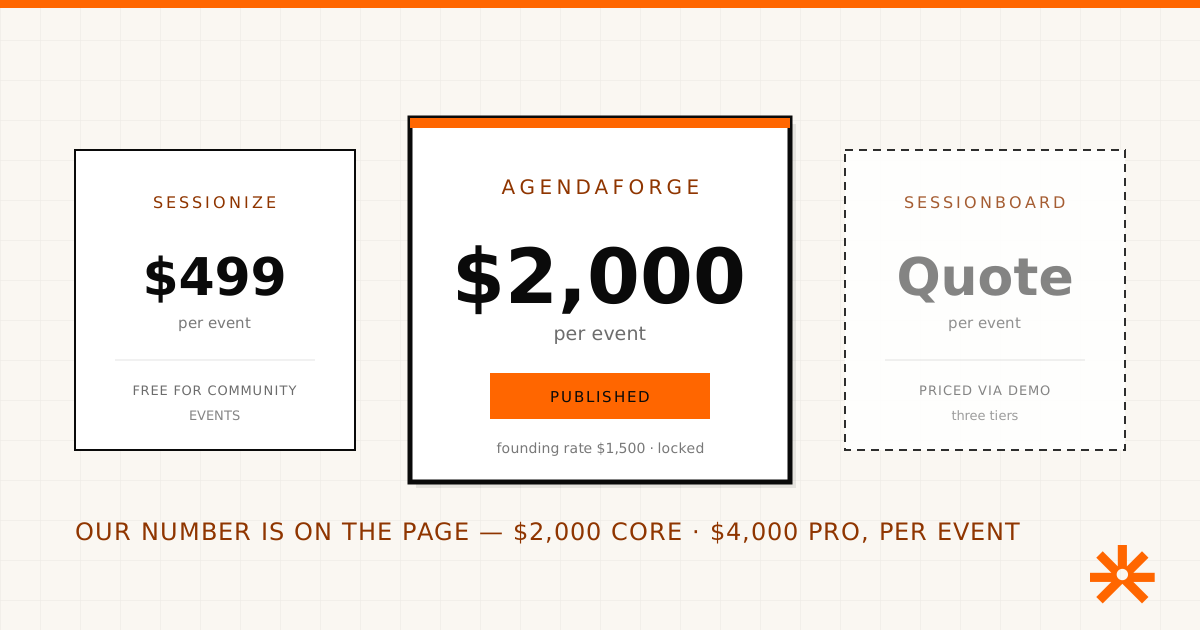
Our prices are on the page: /pricing lists Core at $2,000 per event and Pro at $4,000 per event, plain text, no gate. Founding partners — the organizers running events with us right now, in exchange for a case study and an honest public review — lock in $1,500 and $3,000, and that rate stays locked for their future events as long as they keep running events with us. If you run three or more events a year, we ask you to talk to us, and the promise there is the same one that governs everything else: you get a number in our first reply, no demo required.
That’s the whole answer. The rest of this post is about why publishing that number is unusual in event software, and why we do it anyway.
What we found researching the category
Before we picked a pricing model, we looked at what everyone else does. The pattern was consistent enough to be a pattern rather than a coincidence.
Sessionize publishes a flat number: $499 per event, and it’s free outright for genuinely free community events. Credit where it’s due — as far as we could find, Sessionize is the other vendor in this category that puts a real dollar figure on a public page. It’s a narrower tool than we are (CFP and session management, not the full directory-through-registration workflow), but the transparency is real and worth naming.
Sessionboard, the closest thing to a direct competitor, publicly lists Professional, Enterprise, and Tailored, but its rendered pricing page does not expose a dollar amount. Professional and Enterprise route buyers to request a demo, while Tailored routes them to sales. The page helps buyers compare plan positioning and included capabilities, but the applicable price, contract term, limits, CRM pricing, and implementation costs still require a quote. We track what is public and what remains unknown in our Sessionboard pricing guide.
Larger enterprise event platforms generally retain a sales-led quote because event size, modules, services, integrations, and contract scope vary. We are not repeating third-party price ranges as if they were vendor-confirmed numbers; the proposal is the authoritative price.
So the category still spans different levels of transparency: Sessionize publishes a flat per-event price and test mode, AgendaForge publishes per-event tiers, Sessionboard publishes its plan structure but not visible prices, and many larger suites require a quote. Our reason for publishing remains the same—we want buyers to know our standard number before a call.
The steelman: why vendors hide the number
It’s easy to wave this off as vendors being cagey, and sometimes that’s fair. But there are real, rational reasons pricing stays hidden in enterprise software, and it’s worth naming them plainly instead of pretending the other side has no argument.
Deal-size variance is real. A 200-person single-track meetup and a 5,000-person multi-track conference with an exhibitor hall are not the same buyer, and a single sticker price either overcharges one or undercharges the other. Quote-based pricing lets a vendor match the number to the actual scope.
Procurement plays games, and a published price gives up leverage. If your list price is public, every enterprise procurement team you ever talk to starts the negotiation from that number and works down. Keeping it private preserves room to negotiate case by case — and frankly, to price different customers differently based on what they’ll bear.
Price discrimination is genuinely profitable. A well-funded conference series and a scrappy volunteer-run community event have very different willingness to pay for the same feature set. Hiding the price behind a sales call lets a vendor charge each one what they’ll actually pay, instead of a single number that’s wrong for both.
None of that is dishonest. It’s a legitimate, common strategy in software sales, and a lot of mature companies running healthy businesses do exactly this. We’re not claiming the moral high ground over the practice in general.
Why we publish anyway
We publish for three reasons specific to us, not because hidden pricing is a sin.
Per-event pricing is simple enough to publish. We charge per event, not per seat, per speaker, or per attendee tier with sixteen add-on SKUs. A number that simple doesn’t need a sales call to explain — it needs a page. If our pricing model required a spreadsheet to quote, we’d probably be having a different conversation about whether to publish it.
Hiding the number costs trust with exactly the people we serve. We build for community and tech-conference organizers — the same audience Sessionize serves, the same audience that reads a “Request a Demo” button as “expensive, and they don’t want to tell me how expensive.” Fair or not, that’s how the button reads. We’d rather remove the question than manage the perception.
We’re asking for trust we haven’t fully earned yet, so we can’t gate the price behind a call. We’re an invite-only startup. Founding partners are taking a real bet on us in exchange for a locked rate and a genuine say in the roadmap. Asking someone to trust an unproven product and book a call to find out what it costs is one ask too many. The number should be the easy part.
The honest part
A few things we’d rather you know upfront than discover later.
We’re invite-only today — the CTA on this site says “Request an invite,” not “sign up,” because that’s what’s actually true right now.
Paid ticketing is not generally available. Registration today means custom forms, ticket types, and free RSVPs on a public event page. If you need to sell paid tickets at scale this month, that’s not what we ship yet, and we’d rather say so than let you find out at checkout.
Prices may change as we learn more about running this business. We’re early. But the founding rate is locked for the organizers who partner with us now, for as long as they keep running events with us — that part isn’t negotiable after the fact. And if the published price ever changes for new customers, it’ll be published, not quietly moved behind a sales call.
That’s the deal. If we ever stop living up to it — if the number gets harder to find, or the founding rate quietly moves — hold us to this post.