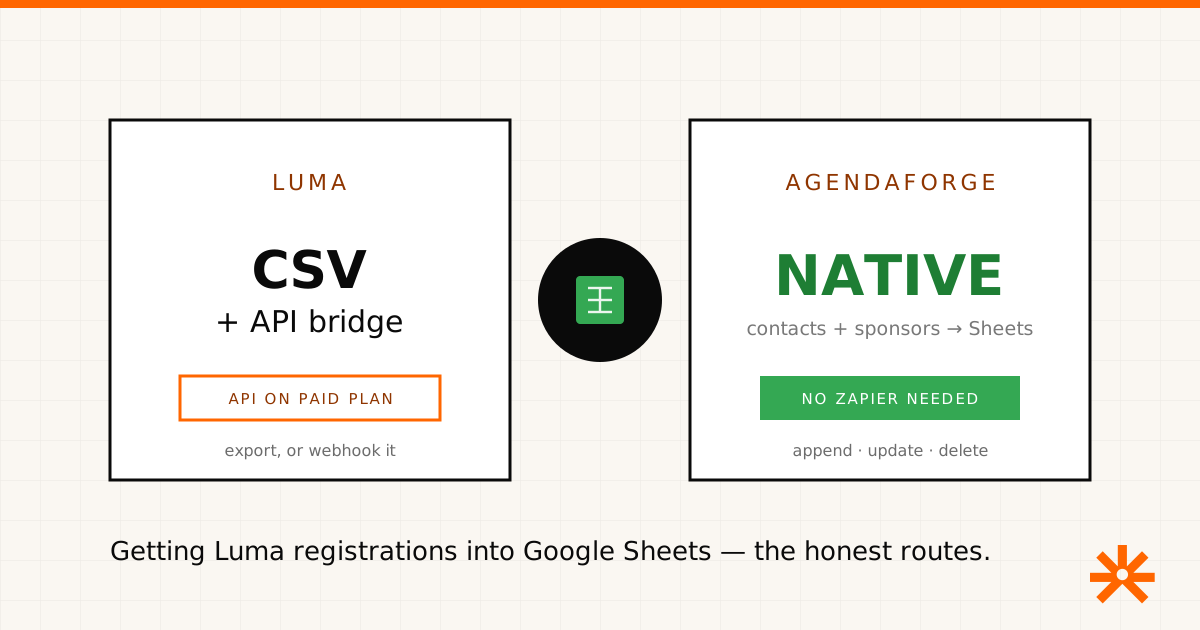
Short answer: Luma has no native Google Sheets integration. There’s no button on your Luma event that keeps a live spreadsheet in sync with registrations. You have two honest routes — the free guest CSV export, or a live bridge built on Luma’s API and webhooks — and the second one has a catch worth knowing before you plan around it: the API sits on Luma’s paid plan. Below is each route, when to use it, and where a genuinely built-in sync exists if that’s what you’re actually after.
Disclosure: we build AgendaForge, an event platform designed to run the content layer of a conference beside Luma — we’ve written an honest map of where Luma stops — and it has its own native Google Sheets sync. We’ll be clear about where that fits and where it doesn’t. Luma details below come from Luma’s own public docs and behavior; features change, so verify before you build.
The two routes at a glance
| Manual export | API / webhook bridge | |
|---|---|---|
| How | Guest list → download CSV | Registration webhook or API poll → add row |
| Requires | Any Luma plan | Luma’s paid plan (API access) |
| Tools | Luma only | A script, or an automation platform (paid) |
| Freshness | Static snapshot — re-export to update | Live — new rows append automatically |
| Direction | One-way, export | One-way, Luma → Sheet |
| Best for | A quick, one-off pull | An always-current list |
Route 1 — the guest CSV export (free, static)
Luma’s native export is straightforward: open your event’s guest management view and download the guest list as a CSV — names, emails, registration status, ticket info, and answers to your registration questions. The file opens straight into Google Sheets or Google Drive.
This is the right call when you need a snapshot — a check-in list the morning of the event, a quick headcount for a sponsor, a one-time import into another tool. What it isn’t is live: the moment someone registers after you export, your sheet is stale. If you’re re-exporting the same list every few hours during launch week, that’s your signal to look at route two.
Route 2 — a live bridge on Luma’s API (paid plan required)
Luma’s attendee layer is genuinely open to being built on: its API covers guests, tickets, ticket types, and registration webhooks. The catch is where it lives — API access is a feature of Luma’s paid plan, so a live sheet is a paid-tier project before you’ve chosen any tooling.
From there you have two styles of bridge. A developer can point a registration webhook at a small Google Apps Script that appends a row per guest — no per-task fees, but you own the code. Or you use an automation platform: connect your Luma API key, trigger on new registrations, and wire it to a Create Spreadsheet Row action in Google Sheets. Check your automation tool’s current Luma support before committing — connector catalogs change — and know the standing limits: the feed is one-way out of Luma, it only captures registrations after you switch it on, and it’s one more integration to keep alive in an already-long tool chain.
When a native sync is what you actually want
If Luma is your front door and all you need is the guest list in a sheet, the routes above are the answer — keep Luma doing what it’s great at. But if you’re wiring spreadsheets because your conference has outgrown a single guest list — a CFP, speakers, sponsors, a multi-track agenda — the spreadsheet is a symptom, and the durable fix is fewer bridges on the content side.
That’s the layer AgendaForge runs, and its Google Sheets integration is built in: connect Google once, pick a sheet through the Google Picker, map fields to columns, and event contacts and sponsors sync automatically — rows append when a record is added, rewrite in place when it changes, delete when it’s removed. No Zapier, no per-task bill. Registrants become contacts, so registration data lands in the sheet the same way.
And here’s the part that’s new since this post first ran: AgendaForge now has a native Luma integration (July 2026). Connect Luma with an API key, bind your event, and Luma guests and orders sync into the CRM as contacts — backfill first, then live webhooks. Because registrants-as-contacts is exactly what the Sheets sync exports, the chain completes itself: Luma → AgendaForge → Google Sheets, live at both hops, with no Zapier and no script to maintain. The full details are here.
The honest caveats, because they decide the call:
- The Sheets hop is one-way, contacts and sponsors only — not two-way, and not sessions or raw form submissions.
- Both hops are paid-tier features — the Luma sync needs Luma Plus on Luma’s side (their API is Plus-only) and AgendaForge’s Pro plan on ours.
- Luma keeps selling your tickets — that’s the design, not a workaround. Checkout, refunds, and the money stay on Luma; AgendaForge owns the CRM and program layer around it.
If you just need registrations in a sheet, export the CSV or build on Luma’s API. If your Luma community is becoming a real conference and you want the speaker and sponsor directory to already live in Google Sheets without a middleman, that’s the gap AgendaForge closes. Our pricing is published — $2,000 per event (Core) or $4,000 (Pro), on the pricing page — and we’re invite-only while we onboard early partners. Tell us about your event and we’ll bring you in.